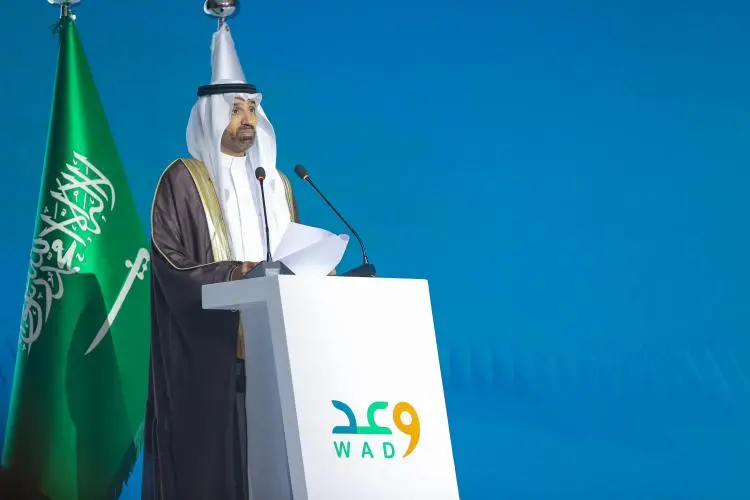
Under the patronage of His Royal Highness Prince Mohammed bin Salman bin Abdulaziz, Crown Prince and Prime Minister – may God protect him – His Excellency the Minister of Human Resources and Social Development, Engineer Ahmed bin Sulaiman Al-Rajhi, participated in the Human Capability Initiative 2025 Conference, held in Riyadh. In his address, His Excellency emphasized that the Kingdom is witnessing fundamental transformations driven by artificial intelligence and the rapid advancement of automation, as part of the Fourth and Fifth Industrial Revolutions. He explained that these transformations are no longer a future prospect, but rather a reality that is reshaping the labor market and its fundamental concepts.
His Excellency clarified that the challenge is no longer the availability of opportunities, but rather the shortage of skills required to fill them. This necessitates redesigning qualification and training models and keeping pace with the rapidly changing needs of the market. He added that while academic degrees remain important, they are no longer the sole path to opportunities, noting that skills have become a primary driver of opportunities in the new labor market.
His Excellency also announced the launch of the National Skills Platform as part of the “Skills Accelerator” initiative. This initiative aims to train over 300,000 individuals in strategic sectors, including energy, healthcare, financial services, and retail, through a comprehensive learning journey and flexible training models that integrate digital and applied learning. This is being done in collaboration with the Human Capability Development Program. The platform utilizes artificial intelligence technologies to classify skills and guide individuals toward training paths best aligned with market demands. His Excellency emphasized that it represents a strategic tool for empowering national talent.
His Excellency stated that the Ministry launched the second phase of the “Wa’ad” National Training Campaign, which aims to provide 3 million training opportunities. The first phase achieved over one million opportunities within half of its target timeframe, with the participation of 60 entities from the public and private sectors.
His Excellency Al-Rajhi noted that the parallel training initiative for women exceeded its target by 22% through partnerships with 70 training institutions and over 45,000 establishments, achieving a 92% job retention rate in the private sector.
The conference also witnessed the signing of two tripartite Memoranda of Understanding between the Ministry of Human Resources and Social Development and both the Ministry of Industry and Mineral Resources and the Ministry of Transport and Logistics, in cooperation with the Human Capability Development Program. This took place under the patronage of His Excellency Dr. Abdullah bin Nasser Abuthnain, Deputy Minister of Human Resources and Social Development for Labor; His Excellency Dr. Abdullah Al-Ahmari, Assistant Minister of Industry and Mineral Resources; and His Excellency Dr. Rumaih bin Mohammed Al-Rumaih, Deputy Minister of Transport and Logistics. The Memoranda aim to support the implementation of the “Skills Accelerator” initiative by providing training programs for targeted sectors, activating digital and media enablers, and developing studies and indicators related to human capacity development.
In his closing remarks, His Excellency the Minister emphasized that human capital development is a fundamental pillar for achieving the goals of Saudi Vision 2030. He added that the Kingdom relies on three pillars to develop its labor market: flexible policies, inclusive opportunities, and integration between the public, private, and academic sectors. This ensures an effective response to global changes and the accelerating pace of change in work environments.
His Excellency highlighted the Ministry’s organizational efforts in building a national skills system, through the establishment of 13 sectoral skills councils with the participation of more than 240 representatives from relevant entities, in addition to developing national professional standards for 300 professions, thus enhancing alignment between training outcomes and labor market needs.